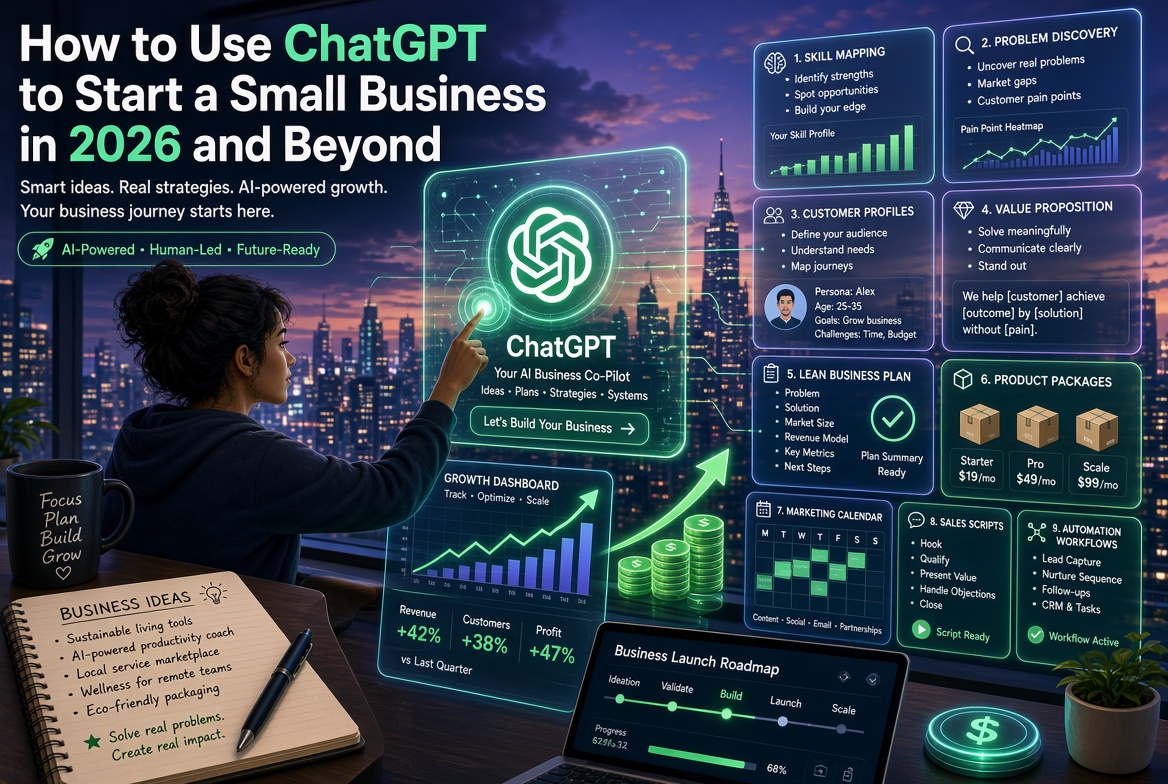
How to Use ChatGPT to Start a Small Business in 2026 and Beyond
ChatGPT is a powerful assistant for starting and growing a small business in 2026 and beyond. It can help with brainstorming ideas, researching customers and markets, developing products or services, writing marketing content, creating business documents, analyzing data, documenting processes, and designing workflows. The key insight is that ChatGPT is a tool—not the business itself. Customers pay for solved problems and real value, not for the fact that AI was used. The most effective approach combines your existing skills and expertise with AI to address genuine customer problems. The article walks through practical steps: identifying your strengths, finding problems worth solving, defining a niche, building a value proposition, creating a lean business plan, developing an initial offer, marketing, selling, automating repetitive tasks, and continuously improving. It also includes a 30-day launch plan and common mistakes to avoid.
Starting a small business has always required creativity, planning, persistence and a willingness to solve problems.
But today, entrepreneurs have something previous generations did not have: powerful artificial intelligence tools that can assist with many parts of the entrepreneurial journey.
Among the most accessible is ChatGPT.
You can use ChatGPT to brainstorm business ideas, research customers, develop products, write marketing content, prepare business documents, analyze information, create workflows and improve productivity.
However, there is an important distinction:
ChatGPT can help you build a business, but ChatGPT is not the business.
Customers do not pay because you used AI. They pay because you solved a problem, saved them time, reduced a cost, improved a result or created something they value.
So the real opportunity is to combine:
Your skills + AI + a real problem + paying customers.
This article explains how you can use ChatGPT throughout the process of starting and growing a small business in 2026 and beyond.
1. Start with Your Skills
Before asking ChatGPT for business ideas, identify what you already know.
Your knowledge and experience can become the foundation of your business.
You might have skills in:
• Teaching
• Statistics
• Accounting
• Marketing
• Programming
• Graphic design
• Writing
• Agriculture
• Photography
• Consulting
• Sales
• Administration
• Engineering
• Healthcare
• Research
Ask ChatGPT:
"Here are my skills and experience: [insert your skills]. Suggest 20 small-business opportunities where I could use these skills to solve real customer problems."
Then ask:
"For each opportunity, identify the target customer, problem being solved, possible solution and potential way to make money."
This gives you a starting point for exploration.
2. Find Problems Worth Solving
A good business usually begins with a problem.
People and organizations spend money to:
• Save time
• Save money
• Make money
• Reduce risk
• Improve convenience
• Increase productivity
• Learn something
• Solve a painful problem
• Obtain a desirable result
Ask ChatGPT:
"List 25 common problems faced by small businesses in my industry that customers might be willing to pay someone to solve."
Don't immediately assume that every AI-generated idea is a business opportunity.
Take the best ideas and investigate them in the real world.
3. Turn Your Expertise into Business Ideas
Suppose you are a teacher.
Your knowledge could become:
• Online courses
• Tutoring
• Training workshops
• Educational materials
• Exam preparation
• Consulting
• Corporate training
Suppose you are a data analyst.
You could offer:
• Data cleaning
• Dashboards
• Statistical analysis
• Business reporting
• Data visualization
• Research support
• Data training
Suppose you understand AI.
You might offer:
• AI training
• AI productivity consulting
• AI implementation
• Workflow automation
• Prompt development
• AI content systems
ChatGPT can help you discover these possibilities.
The key is to turn knowledge into a useful customer outcome.
4. Choose a Specific Target Market
One of the biggest mistakes new businesses make is trying to serve everyone.
Instead, start with a specific group.
For example:
"I help businesses."
is broad.
Compare that with:
"I help small professional-service businesses automate repetitive administrative tasks."
The second statement is easier to understand.
Ask ChatGPT:
"Give me 15 potential niches for my business and explain the specific problems each niche faces."
Potential niches could include:
• Small retailers
• Restaurants
• Schools
• Consultants
• Real-estate businesses
• Law firms
• Churches
• Nonprofit organizations
• Healthcare organizations
• Professional associations
Then investigate which market actually has demand for your solution.
5. Define Your Ideal Customer
Once you choose a possible niche, create a customer profile.
Ask ChatGPT:
"Create an ideal customer profile for a small-business owner who needs help automating repetitive administrative work."
You can explore:
• Customer characteristics
• Business size
• Problems
• Goals
• Buying motivations
• Objections
• Budget considerations
• Decision-making process
You can then use this information to improve your product and marketing.
6. Research Your Market
ChatGPT can help you design your market research.
Ask:
"Create 15 interview questions I can ask potential customers to determine whether they have a problem worth solving."
You can use the questions in:
• Customer interviews
• Surveys
• Focus groups
• Online questionnaires
You can then feed appropriately anonymized responses into ChatGPT and ask:
"Analyze these responses. Identify recurring problems, common needs, objections and possible opportunities."
For current market statistics, competitor prices, regulations and other time-sensitive information, verify the information using current authoritative sources.
________________________________________
7. Study Your Competitors
You don't need to fear competition.
Competition can help you understand the market.
Give ChatGPT information about your competitors and ask it to organize the information into categories such as:
• Products
• Services
• Target market
• Pricing structure
• Positioning
• Marketing
• Customer experience
Then ask:
"Identify possible areas where a new business could differentiate itself."
Your differentiation might involve:
• Specialization
• Better customer service
• Convenience
• Speed
• Personalization
• Quality
• Local expertise
• Education
• Technology
Avoid competing only by being cheaper.
8. Develop Your Value Proposition
Your value proposition answers a simple question:
Why should someone buy from you?
A useful framework is:
We help [customer] solve [problem] by providing [solution], enabling them to [benefit].
For example:
"We help small businesses reduce repetitive administrative work by implementing practical AI workflows, enabling owners and employees to spend more time serving customers."
Ask ChatGPT to create 10 versions of your value proposition.
Then choose and rewrite the one that best represents your actual business.
9. Build a Business Model
Now ask ChatGPT to help you answer:
• Who pays?
• What do they buy?
• How much might they pay?
• How will they find you?
• How will you deliver the service?
• What will it cost?
• What resources do you need?
• What partners might you need?
You can ask:
"Develop a simple business model for this business idea. Identify customers, value proposition, products, revenue streams, costs, channels and key activities."
Then ask ChatGPT to challenge the model:
"Identify the assumptions in this business model that I need to test before investing significant money."
This is an important step.
10. Create a Lean Business Plan
You don't necessarily need a huge business plan before starting.
Create a practical one-page plan covering:
1. Business idea
2. Problem
3. Target customer
4. Solution
5. Value proposition
6. Competitors
7. Marketing
8. Sales
9. Operations
10. Startup costs
11. Revenue model
12. Risks
13. First 90-day goals
ChatGPT can create the first draft.
You provide the real-world information.
11. Develop Your First Product or Service
Don't try to build everything at once.
Start with one clear offer.
For example:
AI Productivity Audit
Review a company's activities and identify opportunities for AI.
AI Staff Training
Teach employees practical AI skills.
Data Analysis Service
Help small businesses turn their data into useful reports.
Social Media Content Service
Create and organize content for businesses.
Online Training
Teach a specific skill through a structured course.
Ask ChatGPT:
"Turn this business idea into three simple service packages: Basic, Professional and Premium. Define the target customer, deliverables and customer benefits for each."
This can help you move from an abstract idea to something you can actually sell.
12. Create Your Business Name
ChatGPT can generate dozens of possibilities.
For example:
"Generate 30 memorable names for an AI automation company serving small businesses. The names should be professional, short and easy to pronounce."
You can also generate:
• Taglines
• Brand descriptions
• Mission statements
• Vision statements
• Brand voice
• Elevator pitches
Before using a name, check its availability and applicable business-registration and trademark requirements yourself.
13. Build Your Website
ChatGPT can help you draft website content.
You can create:
• Homepage
• About page
• Services page
• Product descriptions
• FAQs
• Contact page
• Landing pages
• Blog articles
• Calls to action
Try:
"Write homepage content for a small AI consulting business. Start with the customer's problem, explain our solution, show the benefits and finish with a clear call to action."
Don't publish the first AI-generated version without reviewing it.
Add:
• Your experience
• Your stories
• Your examples
• Your customer results
• Your personality
That makes the website more authentic.
14. Create Your Marketing Strategy
ChatGPT can help develop your marketing plan.
Ask:
"Create a 90-day marketing plan for a new AI consulting business targeting small businesses."
The plan could include:
• Social media
• Blogging
• Email marketing
• Webinars
• Partnerships
• Referral marketing
• Search-oriented content
• Lead magnets
• Community engagement
You can then ask ChatGPT to turn the strategy into a weekly schedule.
15. Create Content That Attracts Customers
Content marketing can help demonstrate your expertise.
Ask ChatGPT to create a content calendar containing:
• Topics
• Headlines
• Hooks
• Content formats
• Target audiences
• Calls to action
For example:
"Create 30 blog and social-media topics for a small AI consulting company. Focus on solving problems faced by small-business owners."
You can turn one topic into multiple formats:
Article → LinkedIn post → Video → Newsletter → Infographic → Short-form video
This allows one good idea to produce much more content.
16. Create a Lead Magnet
A lead magnet is a useful free resource that helps attract potential customers.
Examples include:
• Checklist
• Template
• E-book
• Guide
• Calculator
• Worksheet
• Prompt collection
• Mini-course
For example:
"Create a 25-point AI productivity checklist for small-business owners."
The best lead magnets solve a specific problem quickly.
17. Create Your Sales Materials
ChatGPT can help you prepare:
• Sales presentations
• Proposals
• Brochures
• Product descriptions
• Email campaigns
• Follow-up messages
• FAQs
• Sales scripts
For example:
"Create a professional proposal for helping a small business automate customer enquiries and appointment scheduling. Include objectives, scope, deliverables, timeline and assumptions."
Always make sure your final proposal accurately reflects what you can deliver.
18. Practice Selling with ChatGPT
Many people are uncomfortable with sales.
You can use ChatGPT for practice.
Tell it:
"Act as a potential customer who is interested in my service but skeptical about the price. Ask me questions one at a time."
You can practice responding to:
• "Why should I choose you?"
• "Why is this worth the price?"
• "Why can't my staff do this?"
• "What results should I expect?"
• "What happens if it doesn't work?"
After the exercise, ask:
"Evaluate my responses and show me how I could communicate more clearly."
This is a powerful way to prepare before speaking to real customers.
19. Create Customer-Service Systems
Once customers start arriving, customer service becomes important.
ChatGPT can help prepare response templates for:
• Frequently asked questions
• Product information
• Customer onboarding
• Appointment requests
• Troubleshooting
• Follow-ups
• Feedback requests
You can build an internal library of approved responses.
For unusual, sensitive or high-impact situations, human review should remain part of the process.
20. Document Your Business Processes
Don't allow important business knowledge to exist only in your head.
Ask ChatGPT to turn your activities into Standard Operating Procedures.
For example:
"Here is how we process a new customer. Turn this into a clear Standard Operating Procedure."
A good SOP can include:
1. Purpose
2. Scope
3. Responsibilities
4. Required information
5. Procedure
6. Quality checks
7. Exceptions
8. Escalation
9. Records
Once a process is documented, it becomes easier to train people and identify automation opportunities.
21. Identify Tasks That Can Be Automated
After documenting your processes, ask:
"Which parts of this workflow are repetitive, rule-based and suitable for AI or automation?"
For example:
Customer enquiry → AI-assisted response → Lead capture → CRM entry → Follow-up
Or:
Order → Confirmation → Invoice → Customer notification → Record update
AI tools and workflow automation platforms can connect different systems and reduce repetitive manual work.
But don't automate everything.
Some tasks require:
• Human judgment
• Professional expertise
• Empathy
• Accountability
• Privacy protection
• Careful review
22. Use ChatGPT for Business Administration
Small businesses often lose valuable time to administration.
ChatGPT can help with:
• Meeting agendas
• Meeting summaries
• Action lists
• Reports
• Internal communications
• Checklists
• Project plans
• Business correspondence
• Templates
For example:
"Turn these meeting notes into a professional action table with Issue, Decision, Action, Responsible Person and Deadline."
A task that might take considerable time manually can often be organized much faster.
23. Analyze Your Business Data
If you maintain sales, customer or operational data, AI can help you explore it.
Depending on the tools and files available, you can ask ChatGPT to assist with:
• Data cleaning
• Missing-value analysis
• Descriptive statistics
• Trend analysis
• Data visualization
• Excel formulas
• Python
• R
• SQL
• Reporting
For example:
"Analyze these monthly sales figures. Identify trends, unusual changes and questions management should investigate."
Always check important calculations and conclusions before making significant business decisions.
24. Use Customer Feedback to Improve
Your first customers can provide valuable information.
Ask ChatGPT to help you design a feedback questionnaire.
You can ask customers:
• What problem were you trying to solve?
• Why did you choose us?
• What did you like?
• What could we improve?
• What additional service would you like?
• What nearly stopped you from buying?
Then analyze the responses.
The process becomes:
Listen → Analyze → Improve → Test
25. Use ChatGPT to Develop New Products
Customer feedback can reveal new opportunities.
Suppose several customers ask for training after purchasing your service.
That could become:
Service → Training → Course → Digital Product
Ask ChatGPT:
"Here are customer comments. Identify recurring unmet needs that could become new products or services."
This can help turn customer feedback into product-development ideas.
26. Build a Prompt Library for Your Business
Don't repeatedly start from zero.
Create reusable prompts for recurring activities.
For example:
Marketing Prompt
Create our weekly content calendar.
Sales Prompt
Draft a personalized follow-up message.
Research Prompt
Analyze this market information.
Customer-Service Prompt
Draft a response using our approved customer-service policy.
Reporting Prompt
Turn these figures into a management report.
Operations Prompt
Turn these notes into an SOP.
Over time, your prompt library becomes part of your company's operating system.
27. Train Your Employees
ChatGPT can help create:
• Training materials
• Onboarding programmes
• Quizzes
• Knowledge tests
• Role-playing exercises
• FAQs
• Customer-service scenarios
For example:
"Create a two-week onboarding programme for a new customer-service employee in a small online business."
This can reduce the time required to prepare training materials.
28. Use AI to Multiply Your Time
One of the biggest benefits of AI is not necessarily replacing employees.
It is allowing people to accomplish more.
For example, a business owner can use AI to assist with:
Research → Writing → Marketing → Administration → Customer Service → Analysis
This can free time for activities that require human judgment and relationship-building.
The goal should be:
Automate repetitive work so that people can focus on valuable work.
29. Build an AI-Powered Business System
Eventually, you can connect different parts of your business.
Imagine:
Website visitor
↓
Lead captured
↓
Lead information organized
↓
Potential customer receives appropriate information
↓
Follow-up reminder created
↓
Appointment scheduled
↓
Proposal prepared
↓
Customer onboarded
↓
Feedback collected
Not every step should be fully automated.
But AI and workflow tools can assist with many of the repetitive parts.
30. Keep Improving Your Business
Starting is only the beginning.
Every month, review:
• Revenue
• Costs
• Customers
• Complaints
• Marketing
• Sales
• Productivity
• Operational problems
Then ask ChatGPT:
"Based on this information, identify patterns, potential problems, questions I should investigate and practical experiments I could consider next month."
This creates a continuous improvement cycle:
Measure → Analyze → Learn → Improve → Repeat
A Simple Formula for Building an AI-Assisted Business
You can remember the entire approach with this formula:
EXPERTISE + PROBLEM + AI + CUSTOMER + EXECUTION
Expertise
What do you know or do well?
Problem
What valuable problem can you solve?
AI
Where can AI make your work faster, better or more scalable?
Customer
Who will pay for the solution?
Execution
Can you consistently deliver the promised value?
If one of these elements is missing, your business idea may need further development.
A 30-Day ChatGPT Business Launch Plan
Week 1 — Discover
• List your skills
• Identify customer problems
• Generate business ideas
• Research potential markets
• Identify competitors
Week 2 — Validate
• Interview potential customers
• Test assumptions
• Define your niche
• Develop your value proposition
• Create your first offer
Week 3 — Build
• Develop the product or service
• Create your brand
• Build your website
• Prepare marketing materials
• Document your processes
Week 4 — Launch
• Contact potential customers
• Publish useful content
• Promote your offer
• Collect feedback
• Improve your product
• Identify automation opportunities
The objective isn't to create a perfect business in 30 days.
The objective is to move from an idea to real-world evidence.
Mistakes to Avoid When Using ChatGPT for Business
Don't Think AI Automatically Creates Money
ChatGPT can increase your capabilities, but customers still need a reason to pay.
Don't Build Before Validating
Test demand before spending significant resources.
Don't Copy Generic AI Content
Your expertise, experience, examples and personality make your content more distinctive.
Don't Automate Everything
Keep humans involved where judgment, accountability or empathy matter.
Don't Trust AI Blindly
AI systems can produce incorrect information.
Verify important facts and calculations.
Don't Ignore Privacy
Protect confidential business information and customer data.
Don't Subscribe to Everything
Use the tools that solve actual problems.
ChatGPT Is a Tool—Your Business Is the Solution
The most important lesson is this:
Don't build a business simply because AI exists.
Build a business because a customer has a problem.
Then ask:
"How can AI help me solve this problem more efficiently?"
That approach is much more sustainable.
A teacher can use AI to create better educational products.
A consultant can use AI to research and prepare client work.
A data analyst can use AI to accelerate analysis.
A marketer can use AI to increase content production.
A programmer can use AI-assisted development.
A small-business owner can use AI to automate repetitive administration.
A researcher can use AI to organize and analyze information.
The opportunity is not simply using ChatGPT.
The opportunity is using ChatGPT to create value.
The Future: Human Expertise + Artificial Intelligence
AI will continue to evolve.
The tools available several years from now may be considerably more capable than the tools available today.
But some fundamentals of business will remain.
People will still need:
• Trust
• Quality
• Expertise
• Communication
• Creativity
• Problem-solving
• Accountability
• Good customer experiences
That means the long-term opportunity is not necessarily AI versus humans.
It is increasingly:
Humans using AI intelligently.
An entrepreneur who learns how to combine expertise with AI can potentially operate more efficiently, experiment more quickly and serve customers in new ways.
Final Thoughts
ChatGPT can become one of the most useful tools in your entrepreneurial toolkit.
You can use it to move through the business journey:
Idea → Research → Validation → Business Plan → Product → Marketing → Sales → Customer Service → Automation → Growth
But don't expect ChatGPT to do everything.
The entrepreneur still needs to:
Think.
Test.
Create.
Sell.
Listen.
Adapt.
Deliver.
Improve.
The real advantage comes from combining your knowledge with the capabilities of AI.
So if you have been thinking about starting a small business, don't begin by asking:
"What can ChatGPT do for me?"
Ask a more powerful question:
"What valuable problem can I solve, and how can ChatGPT help me solve it better?"
That is the mindset that can turn artificial intelligence from a fascinating technology into a practical business advantage.
Learn AI.
Build with AI.
Create value.
Grow your business.
Adamschrisco — Learn | Build | Grow.
Back to Blog
Comments
Be the first to comment.